
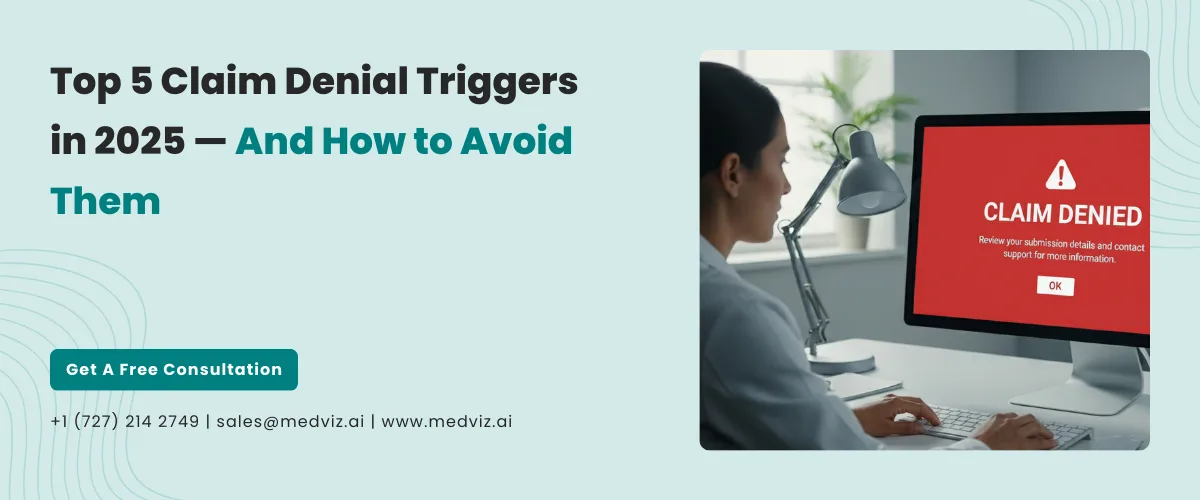
Table of Contents
- Introduction: Why Claim Denials Are on the Rise in 2025
- Understanding Claim Denials in 2025
- Top 5 Claim Denial Triggers in 2025
- The Hidden Costs of Claim Denials
- Proven Strategies to Prevent Claim Denials
- How Technology Is Transforming Denial Management
- Expert Tips & Best Practices
- Conclusion: Winning the Claim Denial Management Battle in 2025
- Partner with Medviz Systems
Introduction: Why Claim Denials Are on the Rise in 2025
Healthcare providers in 2025 are facing a denial crisis unlike anything in prior years. According to KFF, insurers denied 19% of in-network claims and a staggering 37% of out-of-network claims in 2023 — the highest denial rates since tracking began in 2015.
The American Hospital Association (AHA) estimates providers spend nearly $20 billion annually reprocessing denied claims. Meanwhile, Chief Healthcare Executive reports hospitals spent $25.7 billion in 2023 alone adjudicating denials.
Yet patients rarely challenge these decisions. KFF found that fewer than 1% of patients appeal denied claims, leaving providers to absorb the administrative and financial strain.
Bottom line: Denial management is no longer a back-office task. It’s a strategic imperative for financial health and patient trust.
Understanding Claim Denials in 2025
What Is a Claim Denial?
A claim denial happens when a payer refuses reimbursement for a submitted claim.
Two categories dominate:
- Soft Denials: Temporary rejections that can often be fixed (e.g., missing codes, documentation).
- Hard Denials: Permanent rejections, typically non-recoverable (e.g., missed deadlines, non-covered services).
The Scope of Denials Today
- Roughly 1 in 5 claims is denied on first submission.
- More than $262 billion in claims are denied annually.
- Denials are increasingly complex, driven by payer-specific rules and rising documentation standards.
- Up to 85% of denials are preventable with better processes.
Top 5 Claim Denial Triggers in 2025
1. Eligibility Errors — Preventable but Costly
Eligibility remains the #1 preventable cause of denials.
Common Causes:
- Inactive or lapsed insurance coverage
- Incorrect demographics (DOB, member ID, etc.)
- Services excluded from patient’s plan
- Coordination-of-benefits not updated
Example: A patient’s coverage lapses mid-month, but the provider doesn’t recheck eligibility on the date of service. The claim is denied, leaving both provider and patient frustrated.
Prevention:
- Real-time eligibility verification at scheduling and check-in
- Re-verify coverage at every visit
- Train staff to spot discrepancies before submission
2. Coding Mistakes & Modifier Errors
Incorrect coding is one of the top reasons for claim denials in medical billing.
Common Mistakes:
- Outdated ICD-10 or CPT codes
- Missing modifiers for bilateral/repeat procedures
- Diagnosis and procedure mismatches
- Incorrect place-of-service codes
Why It Matters: Coding errors not only cause denials but also expose providers to audits and penalties.
Prevention:
- Regular coding audits
- AI-driven coding validation tools
- Ongoing coder/clinician training
- Use of claim scrubbers for pre-submission checks
3. Incomplete Documentation
Documentation gaps often result in hard denials that cannot be overturned.
Examples:
- Missing physician signatures
- Absent operative reports or lab results
- Insufficient justification for medical necessity
- Missing prior authorization proof
Prevention:
- EHR-integrated documentation checklists
- Training providers on payer requirements
- Auditing high-risk specialties regularly
- Embedding clinical prompts in workflows
4. Timely Filing Issues
Late filing is a common — and often irreversible — cause of denials.
Data: Timely filing issues account for 4–7% of denials annually.
Example: A backlog caused by system downtime delays submission past payer deadlines, resulting in unrecoverable revenue loss.
Prevention:
- Automated deadline alerts
- Centralized payer calendar
- Claim submission within 24–48 hours of service
5. Payer-Specific Rules & Duplicate Claims
Every payer enforces unique rules, often updated frequently. Noncompliance leads to rejection.
Examples:
- Duplicate claims submitted before the original is processed
- Wrong modifier under payer-specific guidelines
- Outdated forms or submission formats
Prevention:
- Maintain an up-to-date payer rules library
- Quarterly staff training on payer policies
- Use claim scrubbers to detect duplicates
The Hidden Costs of Claim Denials
1. Financial Costs
- $118–$125 per denied claim in administrative rework costs
- $5 million annually in revenue lost per hospital due to denial inefficiencies
- 11.8% initial denial rate reported in 2024, continuing into 2025
- Double-digit increases in coding-related denials across inpatient and outpatient claims
Takeaway: The financial toll of denials is accelerating, straining budgets and forcing providers to invest more resources in revenue cycle operations.
2. Operational Strain
- Billing teams spend more time fixing errors than preventing them
- Staff burnout rises in high-denial environments
- Resources are diverted away from proactive strategies
3. Patient Impact
- Denials often shift costs to patients, leading to surprise bills
- Patient trust declines when denials cause financial stress
- Poor financial experiences hurt patient retention
Proven Strategies to Prevent Claim Denials
- Automated Eligibility Verification – stops errors before claims are submitted.
- Coding Audits & AI Tools – ensure accuracy and compliance.
- Documentation Protocols – standardized templates reduce gaps.
- Filing Automation – alerts and calendars prevent late submissions.
- Payer Compliance Monitoring – ongoing training and updated payer libraries.
How Technology Is Transforming Denial Management
Artificial Intelligence & Predictive Analytics
AI models analyze denial patterns and predict high-risk claims before submission.
Automated RCM Platforms
Claim scrubbers and real-time eligibility checks reduce front-end denials.
Denial Trend Analytics
Dashboards help providers identify root causes and adjust processes proactively.
Industry Results
- Up to 30% fewer denials
- Faster reimbursement timelines
- Lower administrative costs
Expert Tips & Best Practices
- Monitor denial trends monthly
- Appeal promptly with complete documentation
- Cross-train billing, coding, and clinical teams
- Collaborate across compliance and RCM departments
- Use technology proactively, not just reactively
Conclusion: Winning the Claim Denial Management Battle in 2025
The leading claim denial triggers in healthcare — eligibility errors, coding mistakes, documentation gaps, timely filing, and payer-specific rules — cost providers billions each year.
But with proactive strategies, AI-powered denial prevention, and cross-functional collaboration, healthcare organizations can:
- Reduce denial rates significantly
- Protect revenue
- Enhance patient trust and satisfaction
Partner with Medviz Systems to Reduce Claim Denials & Boost Revenue Cycle Efficiency
📞 Call Medviz Systems at +1 (727) 214-2749
📧 Email: sales@medviz.ai
At Medviz Systems, we help healthcare organizations:
- Improve claim accuracy
- Reduce administrative waste
- Accelerate reimbursements
So your team can focus on delivering exceptional patient care — not chasing payments.
Leave a Reply to Top 3 Denial Trends From 2025 You Can Still Reverse in 2026 Cancel reply